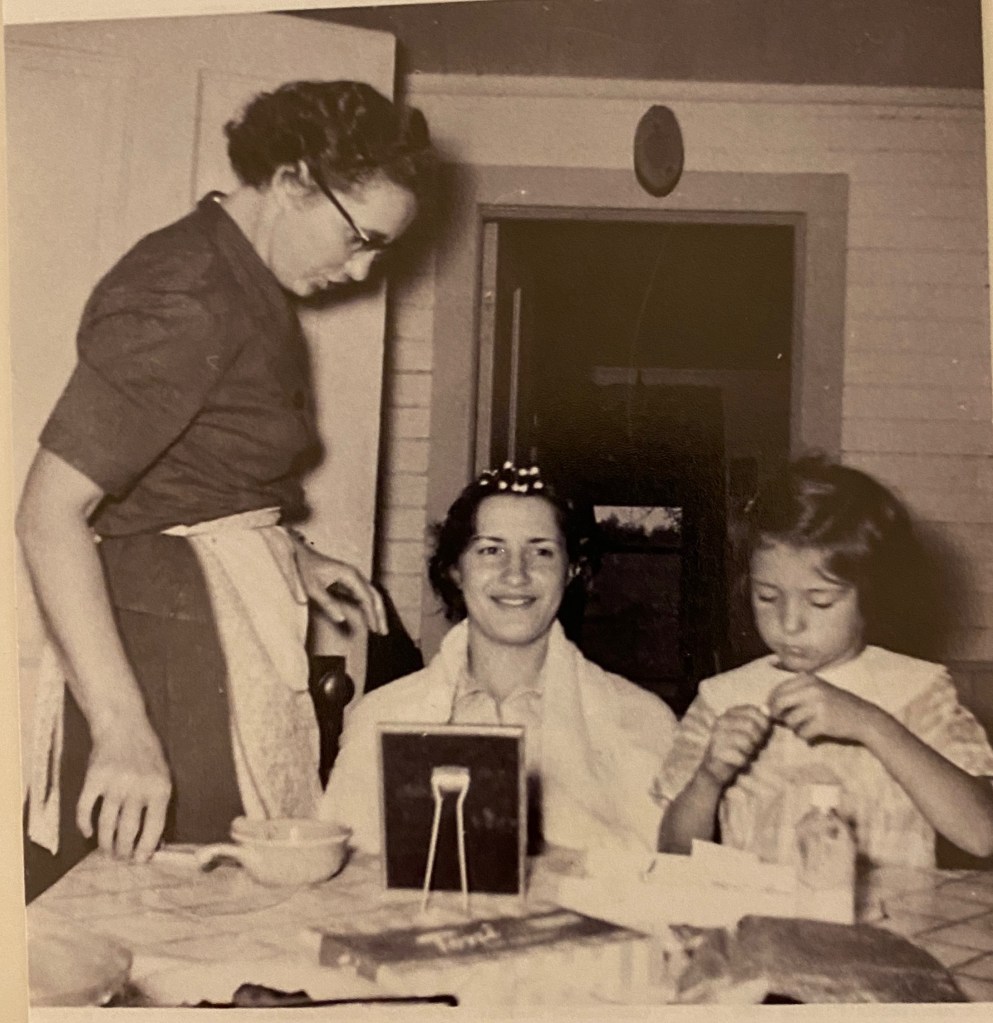
The room is as it has always been, at least as far back as my memory reaches. The recollections I have are not linear, nor are they all mine. They layer atop one another like transparencies, creating a deeper, more intricate image of the life that room held. Underneath the layers there lie a few faded photographs, reminding me of the life that was there before mine was. Those images make the room more real to me, more solid and sure. I can depend on this room.
I sit in a chair, perched atop two phonebooks, at the long kitchen table. The table’s short side butts up against a wood paneled wall, which is painted mint green and adorned only by a large print of The Last Supper. There is a fresh palm branch tucked behind the frame, reminding of of the time of year. My mother and aunt flank me, the other grandchildren are either too young or too old to partake in this holiday tradition. The eggs have been boiled and cooled, sitting in a ceramic bowl on the newspaper covered table. Ceramic coffee mugs, mismatched and lined up on the table, are filled with colored water and the smell of vinegar is in the air. My mother’s slender fingers, stained from the dye tablets, hold an egg and tenderly demonstrate how to draw on it with a clear wax crayon that will resist the dye. My grandmother, short gray hair recently set and styled, wearing a faded blue housedress and an apron with ruffled edges and a calico print, black leather laced shoes on her feet, stands at the wood burning stove preparing the noon meal for the menfolk who will be back from the fields soon. The stove, white and commanding, sits on the wall to the living room next to a wood filled cabinet, providing what I will come to recognize as a signature scent of my childhood. (I recently saw a photograph of my grandmother from that era and was struck by how much she looked like a character from a Steinbeck novel, and I wonder if this is why I have always been drawn to his work.) She fries slabs of ham in a cast iron skillet and sliced potatoes with lard in another, stirring and flipping with her right hand, her left hand on her hip as she talks about crop futures, weather, local gossip, and other things about which I have no interest. The daughter of Polish immigrants but raised in the upper midwest, her accent is neither traditional Polish nor classic Minnesotan. Instead, she has a staccato, matter of fact way of saying things, trading the “th” sound for “d” (“Give me dat dere boowl”) and referring to multiple people as “yous” or, when she was making a point, “yous guys.” The crackle of the frying food is the harmony to our chatter, and the aroma is wafting over to me, salty and rich, and I know my belly will soon be full.
We have crowded around the table, pulling up extra chairs to accommodate a dozen or so people. I am perhaps 8 years old, and I have graduated to sitting without a boost, the phonebooks are now assisting the younger children. My grandfather sits at the head of the table. He is neither short nor tall, his build is slight and his ruddy, leathered skin gives away a lifetime of labor. His cheeks are hollow, his nose wide, his eyes rarely make contact with mine. He is stoic and intimidating, but not frightening. On top of his head is a shock of curly hair that is fading from near black to gray. He keeps it trimmed on the sides but longer on top, and you can tell that he once wore it in a proud pompadour. He still has it cut in that style, but he no longer oils it back as his younger self did. He now leaves it unruly and untamed, but I find comfort in this. His is missing the nail on the ring finger of his left hand, but I don’t know this is unusual until I am older. I assume all grandpas on farms are missing nails. He is a product of the Great Depression, and this is never more apparent than when he eats.
Conversation at the table buzzes around him but he does not speak; he is there for only the task at hand: nourishment. He begins with a leg or a wing of chicken, floured and fried by my grandmother. He is not subtle in the way he eats, nor is he ashamed. His lips smack as his teeth rip the meat from the bone and he chews loudly, unbothered by manners. He continues until it’s clear to everyone near him that the flesh is gone and it is time to set it aside. Instead, my grandfather is determined to get every morsel from it, loudly sucking the last bits of meat from the bone and any marrow he can get from within. When he moves on to the creamed corn (brought up from the root cellar in the center of the room) and fried potatoes, he has a fork in his right hand and his left arm resting on the table, curled protectively around his plate. Just when you are certain he has eaten all that is possible, he reaches for a slice of bread and uses it to purposefully sop up anything left to be consumed. He leaves his plate as clean as it was when he sat down.
After the meal my grandmother, my mother, now closer to 30 years old than to 20, and her two older sisters clear the table and begin the routine of cleaning up. My grandmother scrapes uneaten food that will eventually be thrown to the dogs or the pigs into a slop bucket near the stove, as my mother and her sisters stand at the porcelain sink that sits opposite the stove and overlooks the yard as they clean dishes; one washes, one dries, and one puts away. They work in assembly line fashion, and you can tell from the ease with which they weave in and out of one another that this is the way it has always been done. There is a quiet banter and when they laugh they sound as one, the laughter airy and uninhibited. I watch them and can see that their relationships have formed and grown over mundane tasks like these for decades, and it makes me feel safe.
My grandfather sits at the table with his two sons as well as my aunts’ husbands and the elder grandsons. The older men lean back in their chairs, toothpicks balancing precariously off of their lower lips. Like the women, they talk and laugh, but it is louder, more boisterous. They have the self assurance of men who know their work is in the fields and not the kitchen. The younger men, some not yet old enough to drive, observe quietly, laughing at jokes they are likely too young to understand. They try to mimic the posture and mannerisms of their elders, but on them it looks stiff and awkward, limbs too long and movements that lack the fluidity men who have earned their pride.
I am older still, perhaps 12 years old. My mother’s brother, her senior by barely a year, sits on a stool in the center of the kitchen, facing the sink. He is a large man, but not overweight. His shoulders are broad and his eyes still twinkle with the mischief he caused in his formative years. He is charming and at ease with himself, and you can see that he has always been well liked. His smile, marked by one silver tooth in the front, is broad, sincere, and ever-present. His laugh is loud and fills my head and my heart. He loves life and I love him. He has a tattered bath towel wrapped around his shoulders over his flannel work shirt. He has my grandfather’s hair, unkempt and overgrown, curls tangled and matted from the wind, making him look a bit like a brunette Albert Einstein. My mother stands behind him, working a comb through his wet hair, hairdresser’s scissors nearby. Her smile comes easily as she listens to her brother talk, and she tries to keep both her hands and his head steady as they laugh together.
There is a flurry of activity all around: grandchildren toddling from adult to adult, pre-teens sitting on the stairs trying unsuccessfully to get the Slinky to slink, my grandmother putting the coffee percolator on the stovetop next to the coffee cake that is cooling for the next morning’s meal, my aunts sitting at the table snapping peas and scolding children as they get underfoot, men sitting at the same table drinking beer, playing cards, and exchanging barbs as men who enjoy each others’ company will do.
I sit on a chair on the wall between the wood pile and the door to the living room, knees pulled up to my chest. We have given up on the Slinky and I am deciding what to do next. I am alone but do not feel lonely; I am observing all that is around me and I feel peaceful because I know that I belong here. These are my people, and this is our true north, the place to which we all gravitate. This is a refuge of calm in my stormy life.
I am 17 years old. We are leaving from a weekend visit at the farm. My grandfather, now a widower for several years, sits in a chair near the front door as we prepare to say goodbye. I am the first to approach him and on an impulse I lean in and put my arms around his neck, kiss him on the cheek and say that I love him. His arm reaches tentatively and offers a weak hug in return. When I stand up I see that he has tears in his eyes. I turn to my mother, confused, and see that her eyes are welling up as well. In the car she asks me why I did that and I tell her the truth: I don’t know why I chose that moment, but I felt like he should know. She says quietly, almost as if to herself, “I don’t know if any of the grandkids have ever said that to him.”
Later that same year we were back at the farm for Christmas. He sat in the reclining chair in the corner of the living room, a large, gift wrapped box in front of him. He unwraps it and inside is a new (and much needed) television set with a remote control. He again tears up, having not dreamed that his family would come together to get him something both so extravagant and so thoughtful. My heart once again fills with love for this man, so unassuming and gentle, and for this family, scattered across the state but bound together as one.
These people are salt of the earth, and I belong to them.
This is the safest place I know.
 Untangled